

Deprogramming Education: At This Intersection
Installment 2: What Awaits Us at the Convergence of Education and AI

"We are at a unique intersection right now - this moment where traditional education, artificial intelligence, and human learning potential converge for the first time in history."
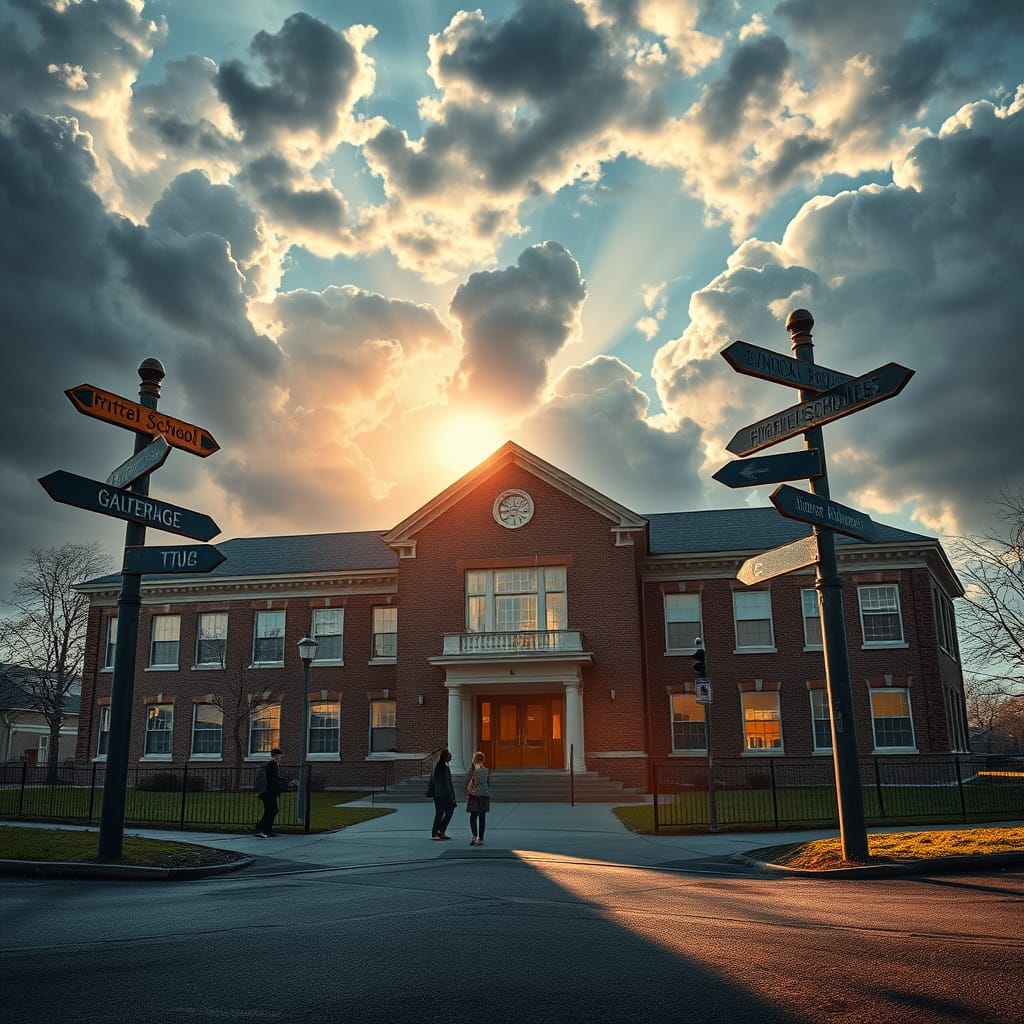
Four weeks into my AI-enhanced technical theatre experiment, I find myself standing at an intersection I never fully anticipated. It's not just the convergence of students, teacher, and subject matter that Parker Palmer describes in educational theory. It's something unprecedented: the intersection where centuries-old educational assumptions collide with artificial intelligence capabilities, forcing us to confront what learning actually is.
Every day in my classroom, I witness this intersection in real time. Students who have been conditioned for twelve years to perform information recall are suddenly partnering with systems that can access any information instantly. The fundamental premise of traditional education… that learning means acquiring and reproducing information… is not just challenged but rendered obsolete.
But what actually awaits us at this intersection? And why does understanding it matter for every educator, parent, and institution grappling with AI's role in learning?
The Educator's View: A Collision of Paradigms
From my perspective as someone who's spent decades in the classroom… but this past year developing AI-enhanced curriculum, consulting with businesses on AI integration, and creating international educational partnerships, this intersection feels monumental. At this convergence, two completely incompatible worldviews meet head-on:
Traditional Education Paradigm: Learning happens when teachers transfer information to students, who demonstrate mastery by reproducing it accurately. Success is measured by information retention and recall. The scarce resource is access to information.
AI-Enhanced Reality: Information is infinite and instantly accessible. The valuable human capabilities are synthesis, creativity, judgment, and meaning-making. Success is measured by what you can create, not what you can remember.
These paradigms cannot coexist. One must give way to the other.
In my technical theatre classroom, this collision happens daily. When a student researching lighting design can access thousands of professional examples, color theory principles, and historical contexts in minutes, what exactly am I supposed to be "teaching" them? When they can generate multiple design approaches using AI partnership, what constitutes their "original work"?
The traditional answer would be to ban the AI tools, force students back into information scarcity, and maintain the fiction that learning equals information transfer. But that approach ignores a fundamental reality: we're not preparing students for a world without AI. We're preparing them for a world where human value lies elsewhere.
The Student's Reality: "Please Lord Let Me Do Actual Art"
But while I'm contemplating paradigm shifts and historical intersections, my students are experiencing something entirely different. When I asked them to reflect on what they notice "at this intersection" of their first experiences in our learning community, here's what I got:
Student 1: "Only men goes crazy • Never met this teacher vro • Lowkey am i cooked being transmasc • Is tech theater a masc class??? • Please lord let me do actual art out here i know very little about tech theater • These floors look old and COOKED • Rugs are fire • Teach has earrings i feel he shouldnt be queerphobic even if he's straight idk tho"
Student 4: "In this intersection I felt worried, tired, and confused. I also questioned where the room was. I was hopeful that I would get a friend to sit with, and happy when I saw him."
Student 6: "At this Intersection there are lines of lights on the ceilings. There is a large open dark room with furniture and computers. At this intersection I am sitting in a tight wooden chair typing on a computer and there is an ambiance of A.C blowing in the background with plants and an earthy scent."
What We Discover at the Intersection
This dissonance between my "institutional" concerns about the best practices for integrating AI into classrooms globally and my students’ immediate human reality reveals something essential. While I'm synthesizing complex transformational patterns across a variety of applications and industry sectors... tracking paradigm shifts, assessment revolutions, and technological disruptions... My students are focused on belonging, identity, and creative expression. This contast illuminates what we discover students actually want in their learning experiences. Here’s what happens when you remove the artificial barriers:
